HISTORICAL COMPREHENSION OF NATURE (EARTH AND UNIVERSE)
- Gilberto Reyes Moreno

- 22 dic 2022
- 17 Min. de lectura
COMPRENSIÓN HISTÓRICA DE LA NATURALEZA (LA TIERRA Y EL UNIVERSO)
Articulo No. 1
Part Three (and final) of Modern Times
Tercera Parte (y final) de los Tiempos Modernos
CONTINUES QUESTIONS AND ANSWERS, From INTERNET
CONTINÚAN LAS PREGUNTAS Y RESPUESTAS, Fuente: INTERNET
OUTER SPACE
EL ESPACIO EXTERIOR
--- How was space created?
During the Big Bang, all of the space, time, matter, and energy in the Universe was created. This giant explosion hurled matter in all directions and caused space itself to expand. As the Universe cooled, the material in it combined to form galaxies, stars, and planets.
--- ¿Cómo fue creado el espacio?
Durante el Big Bang, fueron creados en el Universo, todo el espacio, el tiempo, la materia y la energía. Esta gigantesca explosión lanzó la materia en todas direcciones y causó que el espacio mismo se expandiera. A medida que el Universo se enfriaba, el material en él se combinó para formar las galaxias, estrellas y planetas.
--- Are there infinite particles in the universe?
There are only 10^80 particles in the observable Universe, so that's much less than the possible configurations of matter in a cubic meter. If the Universe is truly infinite, if you travel outwards from Earth, eventually you will reach a place where there's a duplicate cubic meter of space.

--- ¿Existe un número infinito de partículas en el Universo?
Hay solamente 10^80 partículas en el Universo observable, entonces eso es mucho menor que las posibles configuraciones de la materia en un metro cúbico. Si el Universo fuese realmente infinito, si viajaras fuera de la Tierra, llegarías eventualmente a un lugar donde hay un metro cúbico duplicado de espacio. (A pesar de que creo que la traducción es correcta, no logro entender lo último)
--- Is the universe finite or infinite?
Two possibilities exist: either the Universe is finite and has a size, or it is infinite and goes on forever. Both possibilities have mind-bending implications.
The answer to this question please finds it in the 24th delivery of the articles of this blog, in January 2023, since the theme is very controversial, requiring a complex analysis.
---¿El universo es finito o infinito?
Existen dos posibilidades: O el Universo es finito y tiene un tamaño, o es infinito y se va para siempre. Pues ambas eventualidades retan a la mente con extrañas implicaciones.
La respuesta a esta pregunta aparecerá en la entrega No. 24ª. de los artículos de este blog, en enero del 2023, pues se trata de un tema controversial que requiere de un análisis complejo.
--- Do virtual particles exist?
Thus, virtual particles are indeed real and have observable effects that physicists have devised ways of measuring. Their properties and consequences are well established and well understood consequences of quantum mechanics.
---¿Existen las partículas virtuales?
Sí, las partículas virtuales son ciertamente reales y tienen efectos observables que los físicos han vislumbrado maneras de medirlos. Sus propiedades y consecuencias están bien establecidas y bien entendidas consecuencias de la mecánica cuántica.
--- Can particles be created from nothing?
But as we will see, we cannot have zero-energy. Instead, the quantum field gently vibrates randomly. Sometimes this produces enough energy to form particles out of seemingly nothing! The particles arising out of the fluctuation of quantum fields are called virtual particles.

---¿Las partículas pueden ser creadas de la nada?
Pero, como veremos, no podemos tener cero-energía. En su lugar, el campo cuántico vibra moderada y aleatoriamente. Algunas veces esto produce suficiente energía para formar partículas de ¡aparentemente de la nada! Las partículas que surgen de la fluctuación de los campos cuánticos son llamadas partículas virtuales.
--- Does dark matter exist?
The phenomenon is called gravitational lensing. By studying how light is distorted by galaxy clusters, astronomers have been able to create a map of dark matter in the universe. A vast majority of the astronomical community today accepts that dark matter exists.
---¿Existe la materia negra?
El fenómeno se llama lente gravitacional y se refiere a la curvatura de la luz al paso de una fuente gravitacional. Estudiando cómo la luz es curvada por los grupos de galaxias, los astrónomos han sido capaces de crear un mapa de la materia negra en el universo. La vasta mayoría de la comunidad astronómica acepta, hoy en día, que la materia negra existe realmente.
--- What are the 6 elements of nature?
All matter in the universe is composed of a mixture of the six elements: Earth, Air, Fire, Water, Light, and Dark. These elements are perfectly mixed and balanced throughout the universe.
---¿Cuáles son los 6 elementos de la naturaleza?
Toda la materia en el universo está compuesta de seis elementos: Tierra, Aire, Fuego, Agua, Luz y Negro. Esos elementos están perfectamente mezclados y balanceados a través de todo el universo.
---What was there before the universe?

In the beginning, there was an infinitely dense, tiny ball of matter. Then, it all went bang, giving rise to the atoms, molecules, stars and galaxies we see today. Or at least, that's what we've been told by physicists for the past several decades.
---¿Qué hubo allí antes del universo?
En el comienzo, hubo una diminuta bola de materia infinitamente densa. Luego, toto ello explosionó, originando los átomos, moléculas, estrellas y galaxias. O, al menos, eso es lo que los físicos nos han dicho durante varias décadas.
---What happened before the Big Bang?
This is another interesting theme, but rather extended, so I do prefer to throw it to 24th. delivery of the articles of this blog, in January 2023.
---¿Qué sucedió antes del Big Bang?
Este es otro tema interesante, pero algo extenso, por ello prefiero lanzarlo para la entrega No, 24ª. de los artículos de este blog, en enero del 2023.
Let us continue with the questions and answers:
Continuemos con las preguntas y respuestas:
--- What's smaller than a quark?
In particle physics, preons are point particles, conceived of as sub-components of quarks and leptons. The word was coined by Jogesh Pati and Abdus Salam, in 1974.
--- ¿Qué partícula es más pequeña que el quark?
En la física de las partículas, los preones son partículas puntuales, concebidos como subcomponentes de los quarks y de los leptones. La palabra fue acuñada por Joseph Pati y Abdus Salam, en 1974.
--- What is the largest particle?
The top quark

Conversely, the largest (in terms of mass) fundamental particle we know of is a particle called a top quark, measuring a whopping 172.5 billion electron volts, according to Lincoln. Quarks are another fundamental particle that, as far as we know, cannot be broken down into more parts.
--- ¿Cuál es la partícula más grande?
El quark superior
La más grande partícula fundamental (en términos de masa) que conocemos es la llamada quark superior, cuya medida es la descomunal 172.5 mil millones de electrón-volts, de acuerdo con Lincoln. Quarks son algunas otras partículas fundamentales que, tanto como sabemos, no pueden ser quebrados en partes menores.
ECTRON MICROSCOPY:
MICROSCOPÍA ELECTÓNICA:
--- Are photons smaller than electrons?
--- What is smaller than a photon?
A typical atom is ~0.1-0.2 nm. An electron is much smaller than an atom. Elementary particles don't have size. If anyone tells you that "electrons are smaller than photons", run away and never listen to him again.
--- Los fotones son más pequeños que los electrones
--- ¿Qué es más pequeño que el fotón?
Un átomo típico es aproximadamente 0.1 - 0.2 nm (nano milímetros). Un electrón es mucho más pequeño que el átomo. Las partículas elementales no tienen tamaño. Si alguien te dice que "el electrón es más pequeño que un fotón", aléjate de él y no le escuches nunca más.
QUANTUM PARTICLE - An Overview
PARTÍCULAS CUÁNTICAS – Una Perspectiva General
--- Is quantum a particle?
There are two classes of quantum particles, those with a spin multiple of one-half, called fermions, and those with a spin multiple of one, called bosons.
--- ¿El cánto es una partícula?
Existen dos clases de partículas cuánticas, aquellas con un giro múltiple de una-mitad, llamadas férmions, y otras con un giro múltiple de uno, llamadas bosones.
--- What are quantum particles made of?
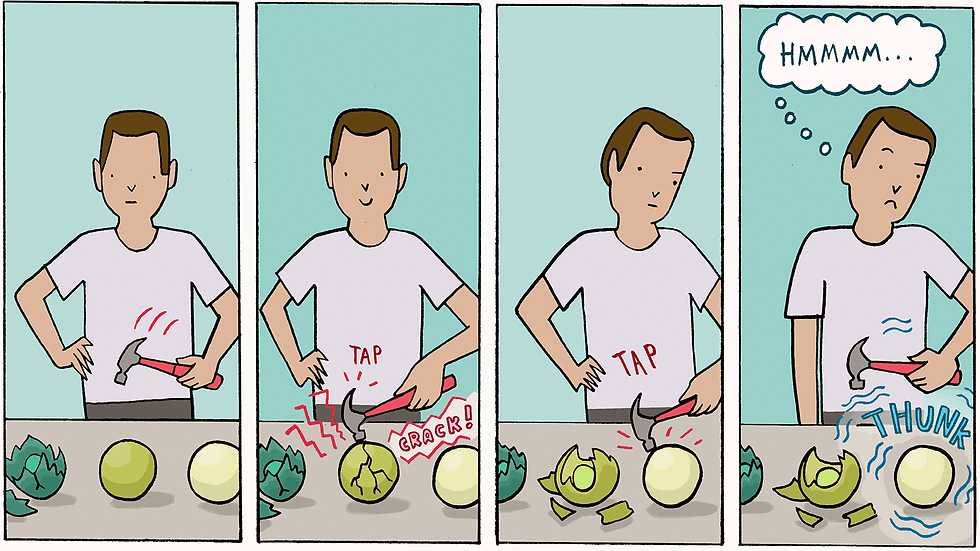
Quantum physics says everything is made of particles, but what does that actually mean? We learn in school that matter is made of atoms and that atoms are made of smaller ingredients: protons, neutrons and electrons. Protons and neutrons are made of quarks, but electrons aren't.
--- ¿De qué están hechas las partículas cuánticas?
La física cuántica dice que todo está hecho de partículas, pero ¿qué es lo que ello significa? Aprendemos en la escuela que la materia estáhecha de átomos y que los átomos están hechos de de pequeños ingredientes, tales como: protones, neutrones y electrones. Protones y neutrones están hechas de quarks, pero los electrones no lo son.
---What are quarks made of? - Physics Stack Exchange
--- Are quarks made of nothing?
Quarks are probably not made of anything more fundamental. The idea that everything must be made of something else is not true. Light is not made of anything else, neither is gravity.
--- Los quarks están hechas de la nada?
Los quarks no están probablemente hechos de nada más fndamental. La idea de que todo esté tiene que estar hecho de algo más, no es verdad. La luz no está hecha de nada más, tampoco la gravedad.
--- Is there anything smaller than a neutrino?
They have been known about for more than 100 years. We have something called the standard model of physics, which is a list of things that are not made of anything else – in other words, the smallest things we know of. That list includes quarks, gluons, electrons, and neutrinos.
--- ¿Exste alguna cosa más pequeña que el neutrino?
Ellos han sido conocidos por más de 100 años. Tenemos algo llamado el modelo estándard de la física, el cual es una lista de cosas que no son hechas de algo más - en otras palabras, las cosas más pequeñas las conocemos. La lista incluye quarks, glunos, electrones y neutrinos.
--- Neutrinos Travel Faster Than Light, According to One Experiment.
--- Los Neutrinos Viajan Más Rápido Que La Luz, de Acuerdo a Un Experimento.
--- Do neutrinos travel faster than light?
If it's true, it will mark the biggest discovery in physics in the past half-century: Elusive, nearly massless subatomic particles called neutrinos appear to travel just faster than light, a team of physicists in Europe reports.
--- Los neutrinos viajan más veloces que la luz?
Si fuese cierto, representaría el mayor descubrimiento en la física en la mitad del Siglo Pasado: Elusivo, una partícula subatómica casi sin masa llamada neutrinos parece que viajaran más rápido que la luz, eso ha reportado un equipo de físicos en Europa.
--- How do we know that particles are real?
There are three ways that scientists have proved that these sub-atomic particles exist. They are direct observation, indirect observation or inferred presence and predictions from theory or conjecture.
--- ¿Cómo sabemos que que las partículas son reales?
Hay tres maneras cómo los científicos han comprobado que esas partículas subatómicas realmente existen. Y son: Observación directa, observación indirecta o presencia de radiaciones infrarrojas, y las predicciónes de la teoría de conjeturas.
Nothingness - Stanford Encyclopedia of Philosophy
La nada - Enciclopedia de la Filosofía de Stanford.
--- Does nothingness exist?
There is no such thing as nothingness, and zero does not exist.
---¿Existe la nada?
No hay tal cosa que se llame nada, el cero no existe.
--- Can we hear sound in space?
No.
--- ¿Podemos oir sonidos en el espacio?
No.
Black Holes Are the Terrifying Behemoths of Space. Here's How They Are
Los Hoyos Negros son los Terroríficos Gigantes del Espacio. Aquí Está Cómo son
--- What's inside a black hole?
What is at the center of a black hole? At the center of a black hole, it is often postulated there is something called a gravitational singularity, or singularity. This is where gravity and density are infinite and space-time extends into infinity.
--- ¿Qué hay dentro de los hoyos negros?

¿Que hay en el centro de un hoyo negro? En el centro de un hoyo negro, se postula a menudo, que hay algo llamado una singularidad gravitacional, o singularidad. Esto es donde la gravedad y la densidad son infinitas y el espacio-tiempo se extiende hacia lo infinito.
WHAT IS GRAVITY?
--- What causes gravity?
Earth's gravity comes from all its mass. All its mass makes a combined gravitational pull on all the mass in your body. That is according to Newton’s interpretation.
Einstein's aproach tells that gravity is caused by space-time curved by mass.
¿QUÉ ES GRAVEDAD?

---¿Que causa la gravedad?
La gravedad de la Tierra se debe a toda su masa. Toda su masa origina una atracción gravitacional combinada a todas las masas en tu cuerpo. Eso es de acuerdo con la interpretación de Newton.
El enfoque de Einstein dice que la gravedad es causada por la curvatura del espacio-tiempo producida por la masa.

WHAT WAS STEPHEG'S THEORY?
In 1974 Hawking proposed that, in accordance with the predictions of quantum theory, black holesemit subatomic particles until they exhaust their energy and finally explode.
¿CUÁL FUE LA TEORÍA DE STEPHEG?
Hawking propuso, en 1974, que, de acuerdo con las predicciones de la teoría cuántica, los hoyos negros emiten partículas sub-atómicas hasta que ellas agotan sus energías y finalmente explosionan.
--- What is Hawking's black hole's forming theory?
That's where Hawking came in. In 1971, he suggested that black holes formed in the chaotic environment of the earliest moments of the Big Bang. There, pockets of matter could spontaneously reach the densities needed to make black holes, flooding the cosmos with them well before the first stars twinkled.
--- ¿Cuál es la teoría de Hawking acerca de la formación de los hoyos negros?
Aqui es donde Hawking hace su aparición: Él sugirió, en 1971, que los hoyos negros se formaron en el caótico mdioambiente de los momentos iniciales del Big Bang
We may finally be able to test one of Stephen Hawking's most far-out idea.
Hawking.
Finalmente, ya somos capaces de comprobar una de las teorías más (¿audaces?) de Hawking.
--- What is Hawking's black hole's radiation theory?
Because of quantum indeterminacy, black holes should emit a tiny amount of light now known as Hawking radiation. Hawking radiation has never been observed, but if it exists the information lost when objects enter a black hole might be carried out of the black hole via this light.
--- ¿Cuál es la teoría de Hawking acerca de las radiaciones de los hoyos negros?
Debido a la indeterminación del cuantum, los hoyos negros deberían de emitir una diminuta cantidad de luz, coocida como la radiación de Hawking. Esa radiación no ha sido observada nunca, pero si existiese la información perdida cuando los objetos entran dentro de los hoyos negros podrían ser transferidos fuera del hoyo negro via esa luz.
47 years later, Stephen Hawking's most important idea was just proven ...
47 años después, la más importante teoría de Stephen Hawking, fue completamente comprobada.
--- Is Hawking radiation real?
Yes.
--- ¿La radiación de Hawking es real?
Sí.
— Do parallel universes exist? We might live in a multiverse
--- ¿Existen universos paralelos? Tal vez estamos viviendo en un multi-universo.
--- Are there multiple universes?
We currently have no evidence that multiverses exist, and everything we can see suggests there is just one universe — our own.
---¿Existen universos múltiples?
Ciertamente no tenemos evidencia que existan universos múltiples, y todo lo que vemos sugieren que hay solamente un universo – el nuestro.
Dark matter | CERN
Dark matter seems to outweigh visible matter roughly six to one, making up about 27% of the universe. Here's a sobering fact: The matter we know and that makes up all stars and galaxies only accounts for 5% of the content of the universe! But what is dark matter?
La Materia Negra I CERN
Toda la materia negra parece que pesa, aproximadamnte, seis veces más que toda la materia visible, haciendo que sea aproximadamente el 27 % del componente del universo. Aquí hay un hecho serio: La materia que conocemos y que constituyen todas las estrellas y galaxias aportan ¡tan solo el 5 % del contenido del universo! Pero, ¿Qué es la materia negra?
--- What makes up 85% of the universe?
Dark matter makes up about 85 percent of the total mass of the universe, and about a quarter (26.8 percent) of the universe's total mass and energy.
--- ¿Que es lo que forma el 85 % del universo?
La materia negra es la que costituye aproximadamente el 85 % de la masa total del universo y poco más de la cuarta parte (26.8 %) de la masa y la energía juntas.
---Is there anything bigger than the universe?
No, the universe contains all solar systems, and galaxies
--- ¿Hay algo más grande que el universo?
No, el universo contiene todo el sistema solar y las galaxias.
--- Why Is the 'God Particle' Such a Big Deal?
--- ¿Por qué la "Partícula Dios" es tan ponderada?

--- What is the God particle theory?
The media calls the Higgs boson the God particle because, according to the theory laid out by Scottish physicist Peter Higgs and others in 1964, it's the physical proof of an invisible, universe-wide field that gave mass to all matter right after the Big Bang, forcing particles to coalesce into stars, planets, and.
--- ¿Cuál es la teoría sobre la partícula Dios?
Los medios de comunicación masiva llaman al boson Higgs la partícula Dios porque, de acuerdo con la teoría propuesta por el físico escocés Peter Higgs y otros en 1964, es la comprobación físca de (que hay) un invisible, campo del tamaño total del universo, que dió masa a toda la materia inmediatamente después del Big Bang, forzando a las partículas para unirse (fusionarse) dentro de las estrellas, planetas, y.
--- Can light be destroyed?

Photons are easily created and destroyed. Unlike matter, all sorts of things can make or destroy photons. If you're reading this on a computer screen, the backlight is making photons that travel to your eye, where they are absorbed—and destroyed.
--- ¿Puede la luz ser destruida?
Los fotones son fácilmente creadas y destruidas. A diferencia que la materia, cualquier tipo de cosas pueden hacer o destruir los fotones. Si tú estásleyendo esto en la pantalla de una computadora, la luz trasera está fabricando fotones que vajan hasta tus ojos, donde son absorbidos – y destruidos.
--- How many subatomic particles exist? - Science Illustrated
There are 36 confirmed fundamental particles, including anti-particles, according to Professor Craig Savage from the Australian National University.
--- ¿Cuántas partículas sub-atómicas existen? - Ciencia Ilustrada.
Hay 36 partículas fndamentales confirmadas, incluyendo anti-partículas, de acuero con el Profesor Craig Savage de la Universidad Nacional de Australia.
The Scientific Proof That Everything is Energy and Reality Isn't Real
El Postulado Científic de Que todo es Energía y Realidad no es Correcto
--- Is reality an illusion?
The further quantum physicists peer into the nature of reality, the more evidence they are finding that everything is energy at the most fundamental levels. Reality is merely an illusion, although a very persistent one.
--- ¿La realida es una ilusión?
Los físicos cuánticos avanzados buscan la naturaleza de la realidad, la mayor evidencia que ellos están encontrando es que todo es energía en los niveles más fundamentales. La realidad es una mera ilusión, aunque muy persistene.
THE TIME
What is Time? – EWT - Energy Wave Theory
EL TIEMPO
¿Qué es el Tiempo? - TOE: Teoría Ondulatoria de la Energía
--- Is time a particle?

Time comes from every particle within our bodies, including our DNA that is made of these same atoms and particles. Time is the frequency of longitudinal energy waves. However, time is not constant. It changes with motion.
--- ¿El tiempo es una partícula?
El tiempo proviene de cada una de las partículos de nuestros cuerpos, incluido nuestro ADN el que está hecho de esos mismos átomos y partículas. El tiempo es la frecuancia de ondas longitudunales. Sin embargo, el tiempo no es constante. Cambia con el movimiento.
Zeptosecond - the smallest time unit ever measured
El zeptoseguendo – la unidad más pequeña del tiempo nunca antes medida.
--- What is smaller than a Zeptosecond?

The only unit of time shorter than a zeptosecond is a yoctosecond, and Planck time. A yoctosecond (ys) is a septillionth of a second.
--- ¿Qué es más pequeño que el Zeptosegundo?
Las únicas unidades de tiempo más cortas que el zeptosegundo son un yoctosegundo y el tiempo de Planck. Un yoctosegundo (ys) es un septillonésimo de un segundo (en el sistema metrico que es septillonésimo?)
--- Does time exist in a vacuum?
--- ¿El tiempo existe en el vacío?
--- Does time exist in empty space?
If the vacuum exists, time absolutely exists as well. For example, if the vacuum were to exist near a source of radiation, particles. They could enter the given vacuum as time passes by so time absolutely exists.
--- ¿El tiempo existe en el espacio vacío?
Si el vacío existiese, el tiempo existiria absolutamente tambén. Por ejemplo, si el vacío fuese a existir cerca de una fuente de radiación, partíçulas. Ellos podrían entrar en el vacío dado como pasa el tiempo, entonces el tiempo absolutamente existe.
Did time have a beginning?
¿El tiempo tuvo un comienzo?
--- When did time begin?
Approximately 14 billion years ago
According to the standard Big Bang model of cosmology, time began together with the universe in a singularity approximately 14 billion year.
--- ¿Cuándo comenzó el tiempo?
Aproximadamente hace 14 mil millones de años.
De acuerdo al modelo estándard Big Bang de la cosmología, el tiempo comenzó junto con el universo en la singularidad, aproximadamente hace 14 mil millones de años.
Einstein: Time Is Relative (to Your Frame of Reference)
Einstein: El Tiempo es Relativo (Para el Marco de Referencia)
--- What did Einstein say about time?
In the Special Theory of Relativity, Einstein determined that time is relative—in other words, the rate at which time passes depends on your frame of reference.
--- ¿Qué dijo Einstein acerca del tiempo?
En la Teoría Especial de la Relatividad, Einstein determinó que el tiempo es relativo – en otras palabras, el ritmo al cual el tiempo transcurre depende de tu marco de referencia.
Components of the Universe
--- What are the 4 main components of the universe?
The universe encompasses all of space, time, matter, and energy. The universe contains everything that exists, from particles of matter smaller than an atom to the largest stars. The universe also includes all forms of energy, from the light you see streaming from stars to invisible radio waves and X-Rays.
Componentes del Universo
--- ¿Cuáles son los 4 principales componentes del universo?
El universo est;acompuesto por todo el espacio, tiempo, materia y energía. El universo contiene todo lo que existe, desde las partículas de materia más pequeñas que un átomo hasta las más grandes estrellas. El universo también incluye en su contenido todas las frmas de energía, desde la luz que ves fluyendo de las estrellas hasta las invisibles ondas de radio y rayos X.
What is the biggest thing in the universe?
Cuál es la cosa más grande en el universo?
--- What is the biggest thing in space?
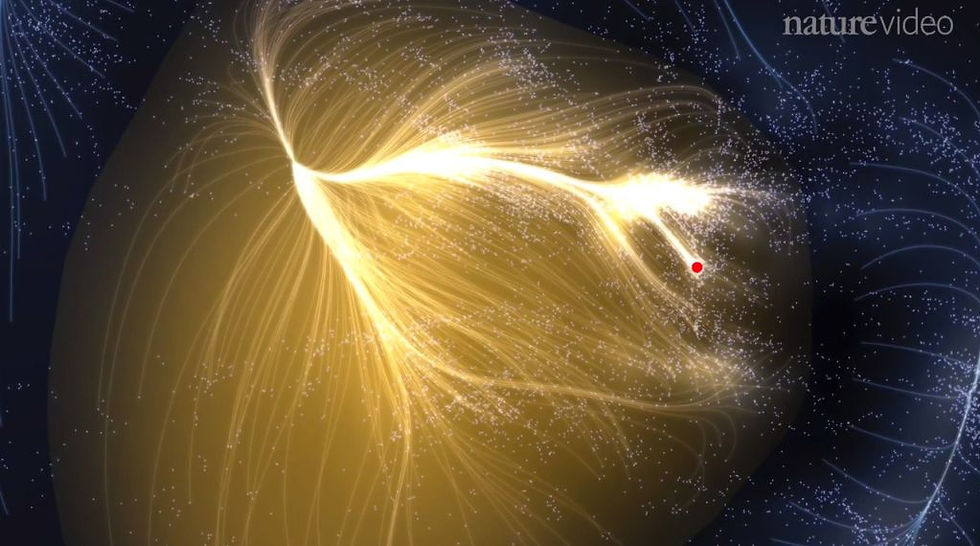
The Hercules-Corona Borealis Great Wall
The biggest single entity that scientists have identified in the universe is a supercluster of galaxies called the Hercules-Corona Borealis Great Wall. It's so wide that light takes about 10 billion years to move across the entire structure.
--- Cuál es la cosa más grande en el espacio?
La Gran Pared de Hercules-Corona Boreal
La más grande entidad que los científicos han identificado en el universo es un super grupo de galaxias llamada La Gran Pared de Hercules-Corona Boreal. Es tan ancha que la luz demora cerca de 10 mil millones de años para atravezarla.
Enter the yoctosecond - Physics World
Entra al yocotsegndo – Mundo de los Físicos
--- How fast is a yoctosecond?
One yoctosecond is one trillionth of a trillionth of a second (10–24 s) and is comparable to the time it takes light to cross an atomic nucleus. Indeed, the researchers say that such pulses could be used to study the ultrafast processes taking place inside nuclei.
--- ¿Cuán rápido es el yoctosegundo?
Un yoctosegundo es uno en un trillonésimo de un trillonésimo de un segundo (10-24s) y es comparable con el tiempo que tarda la luz en atravezar un núcleo atómico. En realidad, los investigadores dicen que tales pulsaciones podrían ser usadas para estudiar los ultrarápidos procesos que se producen dentro del nucleo (atómico) (Es necesario tranformar esas unidades de tiempo del sistema inglés al del métrico decimal)
Meet the zeptosecond, the shortest unit of time ever measured
Familiarízate con el zeptosegundo, la unidad de tiempo más corta nunca antes medida.
--- What is the shortest time possible?
Scientists have measured the shortest unit of time ever: the time it takes a light particle to cross a hydrogen molecule. That time, for the record, is 247 zeptoseconds. A zeptosecond is a trillionth of a billionth of a second, or a decimal point followed by 20 zeroes and a 1.
--- ¿Cuál es el tiempo más corto posible?
Los científicos han medido la unidad de tiempo más corta que nunca antes lo hicieron: El tiempo que tarda una partícula de luz en atravezae una moécula de hidrógeno. Ese tiempo, para el recod, es 247 zeptosegundos. Un zeptosegundo es un tillónésimo de un billonésimo de un segundo, o un punto decimal seguido de 20 ceros y un 1 (Es preciso transformar eso valores del sistema de unidades inglesas al del métrico decimal)
UCF Researchers Set Record for Fastest Light Pulse — Again
Los Investigadres UCF, Han Logrado el Record Para la Más Rápida Pulsación de Luz – Otra vez.
--- Does an attosecond time defy the velocity of the light?
The group led by Professor Zenghu Chang beat its own record set in 2012: a 67-attosecond extreme ultraviolet light pulse that was the fastest at the time. At one-quintillionth of a second, an attosecond is unimaginably fast. In 53 attoseconds, light travels less than one-thousandth of the diameter of a human hair. (It seems that the velocity meassured is 53 attoseconds, a new shortest time meassured record)
--- ¿Un attosegundo es un lapso que desafía a la velocidad de la luz?
El grupo (de investigadores) liderados por el Profesor Zenghu Chan rompió su propio record alcanzado en 2012, midiendo 67 attosegundos de una pusación extrema de luz ultravioleta, la que es la mdición más corta lograda ahora. A una-quintillonésima de un segundo, un attosegundo es inimaginablemente rápido. En 53 attosegundos, la luz viaja menos que un milésimo del diámetro de un cabello humano. (parece que la velocidad medida es 53 attosgundos, un nuevo record del tiempo más corto medido)
--- Does the God particle exist?
In 2012, scientists confirmed the detection of the long-sought Higgs boson, also known by its nickname the "God particle," at the Large Hadron Collider (LHC), the most powerful particle accelerator on the planet. This particle helps give mass to all elementary particles that have mass, such as electrons and protons.
--- ¿Existe la partícula Dios?
En 2012, los científicos confirmaron la detección de uno de los más largamente pensados boson de Higgs, tambien conovigo con el apelativo "partícula Dios" , en el "Large Hadron Collider (LHC), el máspotente acelarador de partículas del planeta. Est partícula ayuda dando masa a todas las partículas elementales que tienen masa, tales como electrones y protones.
--- What is the most powerful particle?
The most energetic particles in the universe, UHECRs pack in ten million times more energy than the particles accelerated inside the Large Hadron Collider. The punch of a UHECR is equivalent to that of a baseball hurtling at 60 miles per hour—astonishingly conveyed in a mere mote the size of an atomic nucleus.
--- ¿Cuál es la partícula más potente?
Las partículas más energéticas en el universo son: los paquetes UHECRs. Con diez millones de veces más energía que las partículas acelaradas dentro del Large Hadron Collider. La fuerza de un UHECR es equivalente a una pelota de beibol lanzada a 60 millas por hora (1640 metros por hora)- asombrosamente comprimido en una mera mota del tamaño del nucleo de un átomo.


Comentarios